
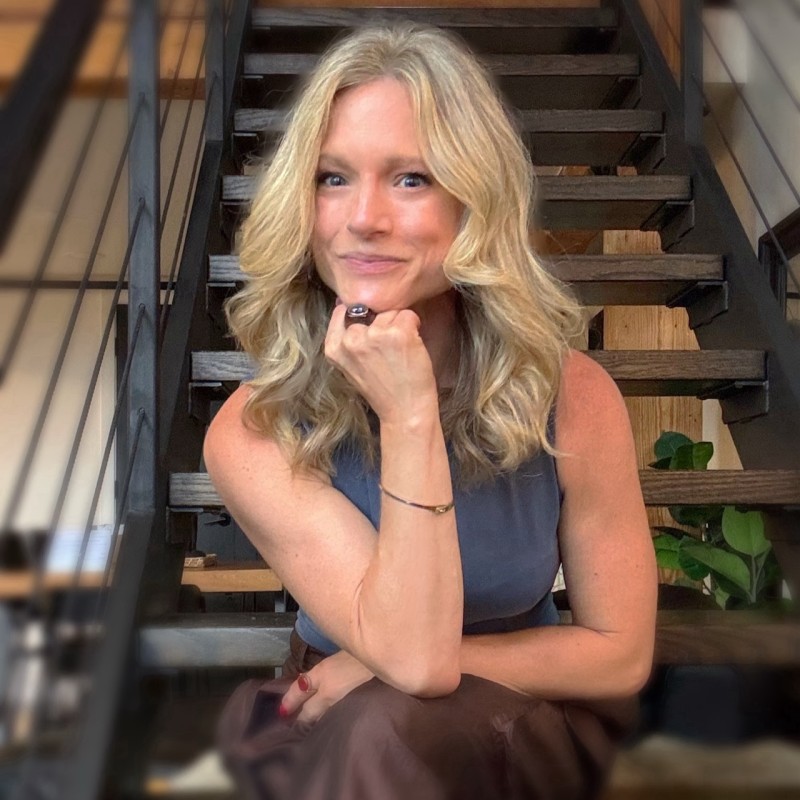
Kristine Campbell
Writer & Youth Sports Advocate, Trainingwrecked
She knew how to achieve, but she had to learn how to trust herself- and then everything started moving.
To reclaim my agency and be motivated by internal reward rather than external validation.
She had spent a lifetime learning how to perform.
Kristine Campbell was not someone who needed to learn how to work hard. A former competitive gymnast and D1 cheerleader, she went on to earn her MBA from Michigan Ross and spend more than 15 years building and leading some of the world's best-known consumer brands. She knew how to analyze a problem, build a strategy and execute against it.
But after leaving corporate life, navigating years of health challenges and turning toward writing and youth-sports advocacy, those same muscles weren't getting her where she wanted to go. She had written books. Researched ideas. Built relationships. Started projects. She even launched Trainingwrecked—and then stopped publishing five months later.
When Kristine came to coaching, she described exactly what she thought she needed: find her “Why,” understand her “Why Not,” determine the right “What,” and build a solid “How.” Underneath all that strategy, though, her confidence in reaching her goals was just 3 out of 10.
What couldn't they see before?
This wasn't a strategy problem. Kristine had spent years succeeding through intellect, discipline, preparation, and performance. When she didn't know what to do next, her instinct was to do what had always worked: think harder, research more, prepare more, and wait until she could see the right answer.
But something else had started showing up in her writing. Coaches told her she was withholding emotion. One described a “performative mask” between Kristine and the reader. Another told her she was hiding behind fiction.
She eventually found Rebecca through a coaching exercise Rebecca was offering to writers: instead of analyzing a fictional character, Rebecca helped writers understand what was driving that character underneath the story. Kristine sent one question: “What if I'm the character?”
She was. And the work wasn't going to be about finding a better plan. It was going to be about understanding why someone so extraordinarily capable couldn't make herself move.
What truth did they uncover?
Her capability was real. It just couldn't be the only thing she trusted. Underneath the perfectionism and constant analysis was a deeper operating system: prove your value through performance. Get it right. Be useful. Be prepared. Don't move until you can defend the decision.
Kristine began learning that emotion wasn't something to manage out of the equation. Intuition wasn't the opposite of intelligence. Not knowing wasn't failure. And her lived experience didn't need another credential before it counted as expertise.
That required more than talking about it. Rebecca built a multidisciplinary coaching team around Kristine, bringing in Andrew Barrett for meditation, Diane Wilde for somatic work, Clara Francesca for communication, Liz Wheeler for wellness and Clay Boykin for vision and strategy. Together, the work addressed the mind, body, voice, habits and future Kristine was trying to build.
Perhaps most tellingly, Kristine had entered coaching skeptical about meditation, breathwork and somatic work—the very kinds of practices that would eventually help her access parts of herself that analysis alone couldn't reach.
What changed once they saw the pattern?
She stopped waiting to feel certain before she started moving. The change wasn't that Kristine stopped being strategic, analytical or ambitious. She learned that she could use those strengths without letting them run everything.
She began pausing instead of immediately reacting. She got clearer about what belonged to her and what belonged to other people. She started setting boundaries without assuming she was responsible for everyone else's response. And she became more willing to choose, act and adjust without first guaranteeing the outcome
Professionally, she stopped requiring herself to have everything figured out before she could claim legitimacy. In one conversation, she deliberately resisted over-preparing, showed up with curiosity instead—and walked away with an invitation to create a program for a conference.
And she started writing again. Not from behind the “performative mask” that had originally stopped her, but with the vulnerability and emotional honesty she had once struggled to put on the page.
What did we measure?
The internal shift showed up in the data. Kristine's Energy Leadership Index Average Resonating Level increased from 3.08 to 3.60 over the course of the engagement.
At the beginning, her energetic center was concentrated around helping, coping, and analyzing. By the end, it had shifted toward opportunity, shared responsibility, and intuition.
Her Level 5 energy—associated with opportunity, curiosity, and win-win thinking—became her strongest energetic level. Her Level 6 energy, associated with intuition and synthesis, also increased substantially.
The numbers mattered. But what mattered more was what they represented: Kristine hadn't lost the strategic mind that had helped make her successful. She had expanded the range of herself she could trust.
In Their Words
“To feel before I fix. To replace pressure, statistics, and scrutiny with presence and softness. To practice discernment and build capacity rather than default to duty and depletion.”
“To reveal my truest creative purpose and structure my life around my personal mission rather than hustle for proof of performance. To choose, start, and pivot rather than wait for certainty to avoid failure.”
“To reclaim my agency and be motivated by internal reward rather than external validation.”
Today, Trainingwrecked brings together parts of Kristine's life that once seemed disconnected: athlete, patient, marketer, strategist, writer and advocate. She is using her experience in youth sports, decades of injury recovery, business background and writing training to investigate the youth-sports system and advocate for safer, healthier outcomes for young athletes.
“Perhaps this next threshold past 50 isn't a finish line at all. Perhaps it's a doorway through which you come home to yourself.”
Start with diagnosis
This is where clarity
begins.
If you’re done performing and ready to see what’s actually there.
The Discovery Call is the right place to start.
©2026, Rebecca Babcock Coaching.